|
InterLitQ: Before moving on to talk about Monoblock, the Spanish film adaptation, with English subtitles, of Burning Down The Tower, to be directed by Tobias Chavez, could you tell us more about the original story and how you came to write it?
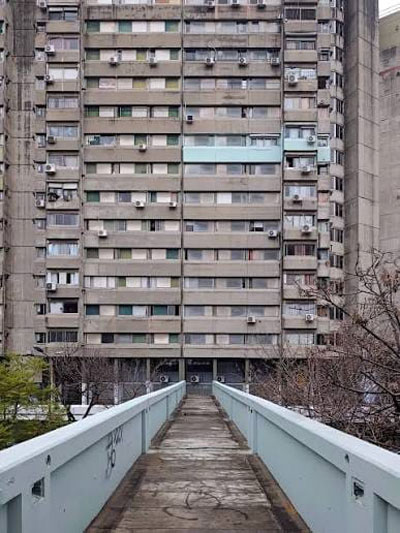
PR: Burning Down the Tower is about two young men in love, who live together on the edge, in a state of virtual poverty. In an urban landscape, the couple move from a small, drab, terraced house in the suburbs to their new dwelling, their lair at the top of a high-rise tower. There, more isolated than ever, they nonetheless feel safe, insulated from a world that they consider to be at odds with them.
InterLitQ: So how does the plot proceed?
PR: I'm not about to give any spoilers. Just let me say that the story grapples with themes such as longing, guilt and redemption.
InterLitQ: How did you and Tobias Chavez begin to collaborate on this project?
PR: It was serendipity. I'd left the city to live in the countryside but, feeling isolated, I returned to Buenos Aires, to live for a month or two in a tower in the center. It was a coincidence that I had already published a story called Burning Down The Tower, much of which takes place in a high-rise. One day I encountered a fellow resident in the lobby, and we struck up a conversation. He told me that he was studying cinema at FUC, whose full name is Fundación Universidad del Cine. Mindful of what he had told me, I sent him Burning Down The Tower, and he said that he liked it, and that he wanted to make a short film based on it.
InterLitQ: In your story, the tower, for all its seeming isolation, appears to represent a spiritual enclave, a refuge from a world that is largely dystopian. Is that the kind of symbolism that you had in mind when writing this narrative?
PR: Quite apart from the sexual symbolism that the tower inevitably lends itself to, I conceived of such an image not only to suggest a bulwark against a world that is at best indifferent and at worst hostile, but also as a metaphor for a love that is monolithic. Of course, an undertone of alienation is there, but the tale's theme is unequivocally romantic, with the central idea being that the two lovers, completely immersed in each other and facing down no end of daily hardship, are essentially immune to any external onslaught.
InterLitQ: In Burning Down the Tower, the protagonist and his boyfriend, while not precisely marginal, barely manage to make ends meet. Do you find yourself increasingly drawn to lives played out on the edge?
PR: I have long been interested in what constitutes separateness and I happened to write Burning Down the Tower during COVID's enforced isolation, which could account for the portrayal of a sustained sense of isolation. I think that I gravitated towards a representation of adversity because, in a depiction of us against the world, I wanted to show that love could triumph against even the most overwhelming odds and, in view of the final resolution, that central conviction holds good. It is the antithesis of J. G. Ballard's 1975 novel High-Rise where, in the setting of a luxury tower, status and isolation are negative forces that propel people's lives into a downward spiral of mayhem.
InterLitQ: Although unspecified in Ballard's novel, critics agree that the tower is located on the outskirts of London. Does Burning Down the Tower share a similar setting?
PR: I was influenced by London. When young, I moved to the south-west of the city, though not to a high-rise. Prompted by a desire to breathe fresher air, I would head up the hill to Wimbledon, a more salubrious area. The text represents the central character also seeking to transcend an environment that he considers to be all too mundane. In the script, written by Tobias Chavez and Federico Fidel Torres Alvarenga, the action is transposed to Buenos Aires, with local color such as images of a profusion of telephone cables obstructing the view of imposing facades, and a chaotic transport system, with buses constantly breaking down, and passengers seething with frustration.
InterLitQ: Apart from having changed London for Buenos Aires, do you feel that the script is faithful to your story?
PR: I refer to what Virginia Woolf states in her 1926 essay, The Cinema, in which she points to the unnatural alliance between literature and cinema, going on to say that cinema can do things that literature cannot, by cutting through visuals and shifting perspectives. And so I think that it would be detrimental if a filmmaker set out to simply reproduce prose when he or she can explore the text in additional ways through experimentation with the rhythm of images that Tarkovsky calls sculpting in time. In Tobias Chavez's adaptation, montage, visual metaphor and pacing are different from in the written version, with many flashbacks that are not in the original story.
InterLitQ: Who is Tobias Chavez, the director of Monoblock?
PR: Tobias Chavez is an emerging Argentine director, born in La Plata, Province of Buenos Aires, in 2003. In addition to having worked as a first assistant director, he has himself directed three short movies: Dulce, which is about the Munchausen syndrome by proxy; Letras Que Arden, a teenage romantic drama; and Piel de Gallina, a short horror movie shown at the film festival Buenos Aires Rojo Sangre.
InterLitQ: Could you tell us more about the Fundación Universidad del Cine and how the film adaptation is progressing?
PR: Former FUC luminaries include directors such as Pablo Trapero of El Clan, Damian Szifron of Relatos Salvajes, Santiago Mitre of Argentina 1985 and Andy Muschietti of It. With regard to the film adaptation of Burning Down the Tower, approximately thirty FUC students are involved in various capacities, and FUC is also providing the necessary cameras and technical equipment. We are still working at obtaining funding for the shooting of Monoblock, which has already started production. Later, in 2027, the film will be shown at both Argentine and international film festivals.
Featured Interviews
|